

Blog
NEWS CENTER
19
2022
-
08
Zhang Haideng: Promoting carbon emission reduction in the steel industry from three aspects
Author:
Zhao Ping
“As a crucial basic industry in the national economy, the steel industry is an energy-intensive and carbon-intensive sector, representing a key battleground for energy conservation and carbon reduction. Its low-carbon development and green transformation are of great significance to the country's achievement of its 'dual carbon' strategic goals.” At the 2022 annual meeting of the Steel Industry Low-Carbon Work Promotion Committee held on August 15, Zhang Haideng, Deputy Director-General of the Department of Raw Materials Industry of the Ministry of Industry and Information Technology, emphasized the importance of promoting carbon emission reduction in the steel industry and affirmed the achievements of a series of work carried out by the Steel Industry Low-Carbon Work Promotion Committee around the national "dual carbon" goals in terms of development paths, key common technologies, and standard leadership.
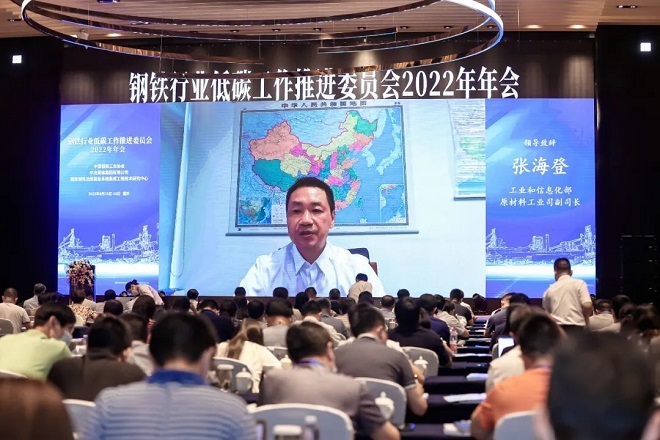
“Promoting carbon peaking in the steel industry is a systematic project.” Zhang Haideng suggested promoting carbon emission reduction in the steel industry and achieving high-quality development from the following three aspects.
First, strengthen top-level design and lay a solid foundation. Zhang Haideng introduced that on August 1, the Ministry of Industry and Information Technology, the National Development and Reform Commission, and the Ministry of Ecology and Environment jointly issued the "Implementation Plan for Carbon Peak in the Industrial Sector," which clarifies the overall goals of the carbon peaking process in the industrial sector. Among them, it encourages the appropriate and steady increase in the development of advanced electric arc furnace short-process steelmaking in the steel industry, clarifying the development goals of "achieving a share of more than 15% for short-process steelmaking by 2025 and more than 20% by 2030"; on February 7, the Ministry of Industry and Information Technology, the National Development and Reform Commission, and the Ministry of Ecology and Environment jointly issued the "Guiding Opinions on Promoting the High-Quality Development of the Steel Industry," which clarifies the principle of green and low-carbon development, combining total quantity control with technological innovation for carbon reduction, and coordinating the synergistic governance of pollution reduction and carbon reduction, with ultra-low emission transformation completed for more than 80% of steel production capacity, ensuring carbon peaking before 2030. "In addition, implementation plans for carbon peaking in key industries such as steel, petrochemicals, nonferrous metals, and building materials will be released in due course." he revealed.
Second, strictly prohibit the addition of new steel production capacity and enhance innovation capabilities. "We must strictly implement the implementation methods for steel production capacity replacement, project filing, and other relevant policies, and resolutely prohibit the addition of new production capacity to ensure that policies are implemented without distortion or deformation." Zhang Haideng stated that in the future, we will continue to consolidate the achievements of steel production capacity reduction and improve the long-term mechanism for preventing overcapacity.
“Promoting the green, low-carbon, and high-quality development of the steel industry is inseparable from technological innovation. We encourage enterprises and scientific research institutions to focus on key common technologies such as low-carbon metallurgy, clean steelmaking, high-efficiency rolling, data-based logistics management, and energy conservation and environmental protection, as well as upstream and downstream collaborative research and development of general-purpose and special equipment and components such as advanced electric arc furnaces, special smelting, and high-end testing.” He introduced that in recent years, the Ministry of Industry and Information Technology has supported the construction of a number of new material production and application demonstration platforms and public service platforms, absorbing relevant units from the industrial chain to achieve synergistic linkage between new materials and end products, and encouraging and guiding industry low-carbon technological innovation in terms of policies and funds.
Third, strengthen industrial restructuring and comprehensively promote energy conservation and emission reduction. Zhang Haideng pointed out that China's steel industry still faces imbalances and inadequacies. It is necessary to gradually increase the efforts to eliminate backward production capacity, promote mergers and acquisitions of enterprises to optimize layout, and promote the transfer of steel production capacity to regions with environmental capacity, energy consumption indicators, market demand, and resource and energy security; actively promote the coupled development and synergistic carbon reduction of the steel, building materials, power, and chemical industries, promote steel-chemical joint production and steel-coke joint production, and improve the comprehensive utilization efficiency of steel slag and other solid waste.
“Developing advanced electric arc furnace steel is one of the key paths to achieving carbon peaking and carbon neutrality in the steel industry.” He stated that the Ministry of Industry and Information Technology will orderly promote the development of electric arc furnace steel and encourage blast furnace-converter long-process enterprises with conditions to carry out on-site transformation and development of electric arc furnace short-process steelmaking. Currently, the Ministry of Industry and Information Technology is promoting the joint development of a leading project for the high-quality development of electric arc furnace steel with Sichuan Province to explore replicable and promotable development models and help the steel industry achieve carbon peaking and carbon neutrality.
Related News


WeChat Official Account
© COPYRIGHT 2025 Zhijiang Jiangrui Shipping Co., Ltd. ALL RIGHTS RESERVED | Powered by 300.cn